Evaporative coolers are common in Spokane's dry summers, and a leaking pan or supply line sends water into ceilings and walls below. Local crews find the moisture and dry the structure before it stains and rots.

Technicians check the float valve, pan, and supply line, then use moisture meters to trace where the leak traveled into the ceiling, wall, or floor below the unit.
Standing water is removed and saturated ceiling or wall areas are opened as needed so trapped moisture near the roof penetration can reach the drying equipment.
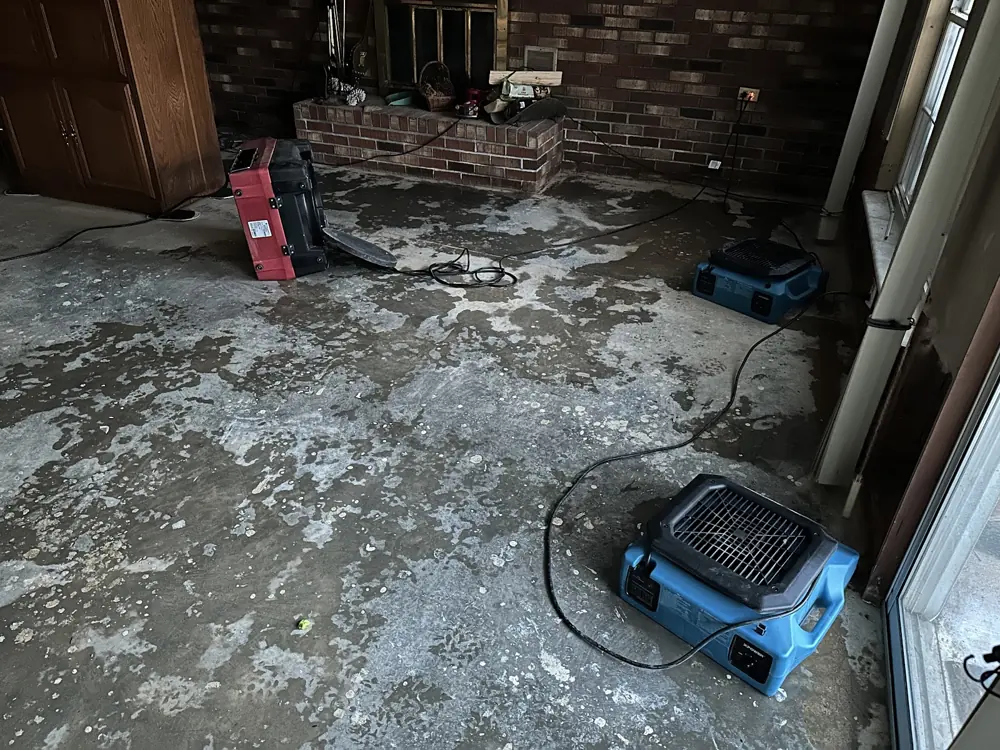
Industrial air movers and dehumidifiers dry the ceiling, framing, and any affected walls or flooring, with readings tracked daily until the hidden space reads dry.
An antimicrobial treatment is applied where dampness fed mold, and stained drywall or flooring is repaired once the structure reaches verified dry readings. Every step is handled with care.

While help is on the way, these first steps, done only where it is safe, limit the damage and protect the insurance claim.
Shut the supply off at the source, or close the home's main valve if the source is not obvious. Stopping the flow limits the damage more than anything else.
Switch off electricity to the affected area, but only if the breaker can be reached without standing in or touching the water.
Get a crew dispatched right away. The sooner extraction and drying begin, the more flooring, drywall, and belongings can be saved.
Take photos and a short video of the water and the affected rooms before anything is moved, so the insurance claim starts strong.
Swamp cooler leak cleanup in Spokane generally runs $700 to $3,800, depending on whether it is a rooftop or window unit, how long the leak ran during the season, and how much ceiling or drywall must be replaced. A quickly caught window unit sits low, while a rooftop cooler that stained and softened the ceiling below costs more. Sudden leaks are often covered by insurance, and the crew documents readings and photos for the carrier.
Crews reach Spokane, Spokane County, and the nearby Inland Northwest fast, from Browne's Addition, the South Hill, and Kendall Yards to Spokane Valley, Liberty Lake, Cheney, and Airway Heights. See the full list on the areas served across Spokane page.
See all areas servedEvery loss is photographed, measured, and logged from the first visit, so the paperwork holds up with the insurance carrier.
Technicians follow recognized IICRC drying standards and prove it with daily moisture readings on Spokane homes, not guesswork.
Emergency dispatch any hour of the day or night, with a real crew on the way across the Inland Northwest, not a callback in the morning.
A real crew dispatched any hour, not a callback in the morning.
Trained technicians following recognized IICRC drying standards.
Truck-mounted, portable, and submersible for any size loss.
The loss is documented and billed to the carrier directly.
Evaporative coolers constantly move water through a float valve, pan, and supply line, so a leak usually traces to one of those. A stuck float lets the pan overflow, a rusted pan develops pinholes, the supply line cracks, or the unit was not drained and winterized properly. Because the cooler runs for hours, even a small leak adds up over the season.
Yes. A rooftop unit sits directly above the living space, so a leak follows the roof penetration and framing into the ceiling below, staining and softening the drywall much like a roof leak would. Because the water collects in the ceiling cavity out of sight, it often spreads for a while before a stain reveals the problem.
No. Turn it off and shut its water supply until the source is repaired, since running it feeds more water into the ceiling or wall with every hour. Getting the leak fixed and the hidden area dried keeps a seasonal drip from soaking the framing and drywall to the point they need replacement.
Service the float valve and pan before the cooling season, replace worn supply lines, and drain and winterize the unit each fall so it does not leak at spring startup. Because these units run all summer in Spokane, a quick pre-season check catches the common failures. Crews can note what they found during cleanup for your service visit.
A sudden failure such as a cracked line or overflow is often covered, while a slow leak from a neglected, unmaintained unit may be excluded. Coverage varies by policy. The crew documents the source, moisture readings, and photos so the adjuster has a clear record to evaluate the water damage claim.
Spokane crews are on call 24 hours a day, local and fast, and can be on the way within the hour.
Call (509) 383-0993