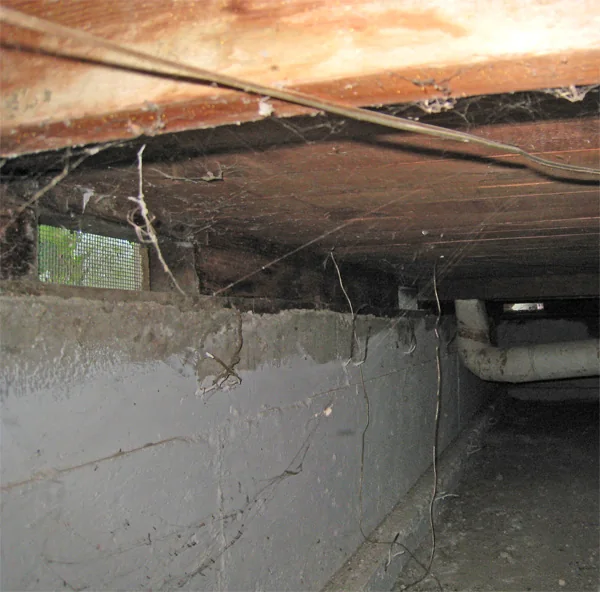
Standing water in a Spokane crawlspace rots joists, soaks insulation, and breeds mold below the living space. Local crews pump out the water, dry the framing, and treat the area to protect the floor above.

Crews pump standing water from the crawlspace, then evaluate the vapor barrier, insulation, and framing for saturation while checking the source of the intrusion. Details are checked at every stage.
Saturated insulation and any ruined vapor barrier are pulled out and bagged, since they trap moisture against the subfloor and cannot be dried in place.
Industrial air movers and commercial dehumidifiers dry the joists, beams, and subfloor while crews apply antimicrobial treatment to wood surfaces showing mold, tracking readings daily.
New insulation and vapor barrier are installed once the wood is dry, and crews can advise on drainage or venting to keep the space dry going forward.

While help is on the way, these first steps, done only where it is safe, limit the damage and protect the insurance claim.
Shut the supply off at the source, or close the home's main valve if the source is not obvious. Stopping the flow limits the damage more than anything else.
Switch off electricity to the affected area, but only if the breaker can be reached without standing in or touching the water.
Get a crew dispatched right away. The sooner extraction and drying begin, the more flooring, drywall, and belongings can be saved.
Take photos and a short video of the water and the affected rooms before anything is moved, so the insurance claim starts strong.
Crawlspace water removal in Spokane typically runs $1,200 to $6,500, depending on the volume of water, how much insulation and vapor barrier must be replaced, and whether joists show rot or mold. A quick pump-out and dry-down sits low, while a long-standing intrusion that damaged framing costs more. Sudden plumbing failures are often covered by insurance, and the crew documents moisture readings and photos for the carrier.
Crews reach Spokane, Spokane County, and the nearby Inland Northwest fast, from Browne's Addition, the South Hill, and Kendall Yards to Spokane Valley, Liberty Lake, Cheney, and Airway Heights. See the full list on the areas served across Spokane page.
See all areas servedEvery loss is photographed, measured, and logged from the first visit, so the paperwork holds up with the insurance carrier.
Technicians follow recognized IICRC drying standards and prove it with daily moisture readings on Spokane homes, not guesswork.
Emergency dispatch any hour of the day or night, with a real crew on the way across the Inland Northwest, not a callback in the morning.
A real crew dispatched any hour, not a callback in the morning.
Trained technicians following recognized IICRC drying standards.
Truck-mounted, portable, and submersible for any size loss.
The loss is documented and billed to the carrier directly.
Warning signs include a musty smell in the home, cupping or soft spots in the floor above, insulation drooping away from the subfloor, and visible dampness or standing water when you look in. Because crawlspaces are out of sight, many homeowners only notice after odor or floor problems appear, so an inspection confirms the extent.
Because the damage moves upward. Wet joists and beams rot and lose strength, saturated insulation falls away and stops working, and the damp, still air carries mold and odor into the living space through gaps in the floor. A wet crawlspace affects the structure and the indoor air of the entire home.
Almost never. Fiberglass insulation soaks up water, sags off the subfloor, and dries far too slowly in a closed crawlspace to prevent mold. Crews remove and bag the saturated material, dry the framing beneath it, and install fresh insulation and vapor barrier once moisture readings confirm the wood is dry.
Crews stage compact air movers and dehumidifiers inside the crawlspace to move air across the joists and pull moisture from the wood, sealing the space so the equipment can work. Readings are checked daily, and drying continues until the framing and subfloor reach a stable dry level rather than just looking dry.
Sudden events like a burst supply line are commonly covered, while gradual groundwater seepage from grading may be excluded. Coverage depends on your policy. The crew documents the source, moisture readings, and photos so the adjuster has a clear record, and reviewing your deductible helps you decide whether to file a claim.
Spokane crews are on call 24 hours a day, local and fast, and can be on the way within the hour.
Call (509) 383-0993