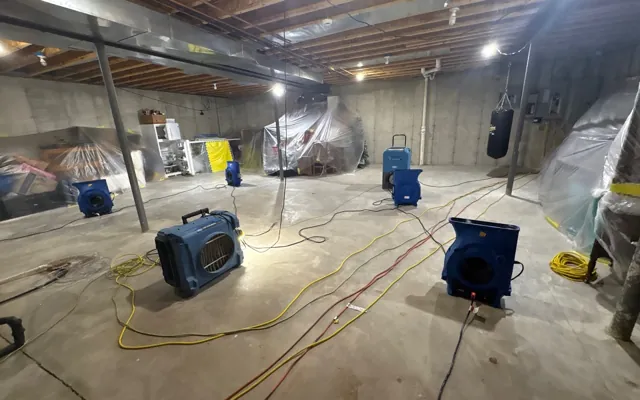
Full basements are common across Spokane, and spring snowmelt, sump pump failures, and burst supply lines put water into them every year. Local crews arrive quickly to extract standing water and dry the structure before mold sets in.

Truck-mounted and portable pumps pull standing water fast while technicians check the source for contamination and flag any structural or electrical hazards before crews step in.
Industrial air movers and commercial dehumidifiers dry foundation walls, joists, and subfloor, with daily moisture tracking to confirm the concrete and framing are releasing water.
Saturated drywall, carpet, and insulation that cannot be salvaged are removed, and surfaces are cleaned and treated with antimicrobial where moisture lingered. Care is taken to protect the home.
Crews rebuild framing, flooring, and drywall once dry and can recommend sump upgrades or drainage improvements to reduce the odds of another flood. Details are checked at every stage.

While help is on the way, these first steps, done only where it is safe, limit the damage and protect the insurance claim.
Shut the supply off at the source, or close the home's main valve if the source is not obvious. Stopping the flow limits the damage more than anything else.
Switch off electricity to the affected area, but only if the breaker can be reached without standing in or touching the water.
Get a crew dispatched right away. The sooner extraction and drying begin, the more flooring, drywall, and belongings can be saved.
Take photos and a short video of the water and the affected rooms before anything is moved, so the insurance claim starts strong.
Basement flood cleanup in Spokane typically runs $2,000 to $8,500, shaped by how much water entered, how long it sat, and whether the source was clean snowmelt or contaminated backup. Finished basements with soaked carpet and drywall cost more than an unfinished slab. Sudden events like sump failure or a burst pipe are usually covered by insurance, and crews document moisture readings and photos for the adjuster.
Crews reach Spokane, Spokane County, and the nearby Inland Northwest fast, from Browne's Addition, the South Hill, and Kendall Yards to Spokane Valley, Liberty Lake, Cheney, and Airway Heights. See the full list on the areas served across Spokane page.
See all areas servedEvery loss is photographed, measured, and logged from the first visit, so the paperwork holds up with the insurance carrier.
Technicians follow recognized IICRC drying standards and prove it with daily moisture readings on Spokane homes, not guesswork.
Emergency dispatch any hour of the day or night, with a real crew on the way across the Inland Northwest, not a callback in the morning.
A real crew dispatched any hour, not a callback in the morning.
Trained technicians following recognized IICRC drying standards.
Truck-mounted, portable, and submersible for any size loss.
The loss is documented and billed to the carrier directly.
Local crews aim to be on site quickly after a call anywhere in the Spokane area, often within about an hour. Fast extraction matters because standing water keeps wicking into framing, flooring, and stored items, so every hour saved lowers both the damage and the final restoration cost.
No. Clean snowmelt or a broken supply line is category one water, while a sewer or drain backup carries contamination and needs disinfection. Technicians identify the source on arrival and handle each type to the right standard, protecting the household whenever contaminated water is involved.
It depends on the cause. Sudden failures like a burst pipe or a sump pump giving out are typically covered, while slow seepage from grading may not be. The crew documents the source and moisture readings clearly so the adjuster has what is needed to evaluate the claim.
In Spokane, where snowmelt drives groundwater into basements each spring, a battery backup is strong insurance against power outages during storms. Crews can assess the pit and recommend a pump sized for the space, since a backup often prevents the exact outage-driven flood that soaked the basement.
Most basements dry in four to eight days, depending on how much water entered and how porous the foundation is. Concrete releases moisture slowly, so crews track readings daily and keep air movers and dehumidifiers running until the walls and slab reach a stable dry point.
Spokane crews are on call 24 hours a day, local and fast, and can be on the way within the hour.
Call (509) 383-0993