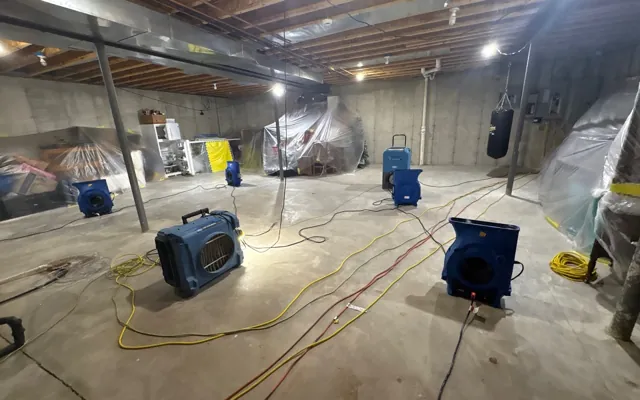
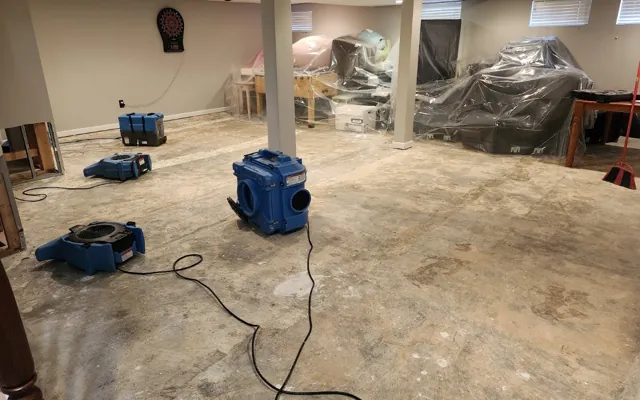
When a basement floods in Audubon/Downriver, WA, local crews respond fast to extract water and dry the structure, following IICRC-standard methods to prevent lasting damage to the home's foundation and living spaces.

Technicians first use powerful pumps to remove standing water fast. They check if the source, like a sump failure or burst pipe, introduced contaminants and note any safety hazards before the full crew begins drying work.
Industrial air movers and dehumidifiers target foundation walls, joists, and the subfloor. The team tracks moisture levels daily to confirm the concrete and wood framing are releasing all trapped water back to a dry standard.
Saturated materials like drywall or carpet that cannot be saved are removed. Surfaces are cleaned and treated. Once everything is verified dry, crews rebuild damaged framing, flooring, and walls, checking details at each stage.

Basement flood cleanup in Audubon/Downriver typically runs $2,000 to $8,500, shaped by how much water entered, how long it sat, and whether the source was clean snowmelt or contaminated backup. Finished basements with soaked carpet and drywall cost more than an unfinished slab. Sudden events like sump failure or a burst pipe are usually covered by insurance, and crews document moisture readings and photos for the adjuster.
Homes in Audubon and Downriver often have full basements, many built in the mid-century, positioned near the Spokane River. This riverside location and aging plumbing systems make these basements vulnerable to seepage, sump pump failures, and burst pipes, especially during spring snowmelt when high groundwater presses against foundations. The neighborhood's position along the river and its older homes create a specific risk. Spring snowmelt and high water tables can lead to basement seepage, while aging pipes and reliance on sump pumps increase the chance of failures during Spokane's cold winters and rapid thaws. From Audubon/Downriver, crews also cover nearby West Hills, Manito/Cannon Hill, Nevada-Lidgerwood, Rockwood, Perry District, Minnehaha. See every neighborhood and town on the full service area page.
See all areas servedEvery loss is photographed, measured, and logged from the first visit, so the paperwork holds up with the insurance carrier.
Technicians follow recognized IICRC drying standards and prove it with daily moisture readings on Audubon/Downriver homes, not guesswork.
Emergency dispatch any hour of the day or night, with a real crew on the way across the Inland Northwest, not a callback in the morning.
A real crew dispatched any hour, not a callback in the morning.
Trained technicians following recognized IICRC drying standards.
Truck-mounted, portable, and submersible for any size loss.
The loss is documented and billed to the carrier directly.
For sudden, accidental events like a burst pipe or sump pump failure, yes, it typically is covered. Local crews document the damage with moisture readings and photos specifically for the insurance adjuster. Slow seepage from groundwater may have different coverage, so homeowners should check their policy.
The timeline depends on how much water entered and how long it sat. For a typical job in Audubon/Downriver, structural drying of concrete and framing often takes 3 to 5 days with industrial equipment. The crew provides daily moisture checks to confirm progress before any rebuild work starts.
Crews are on call 24 hours a day and can be on the way to Audubon/Downriver within the hour.
Call (509) 383-0993